“If you want a vision of the future, imagine a boot stomping on a human face -- forever.” George Orwell, 1984
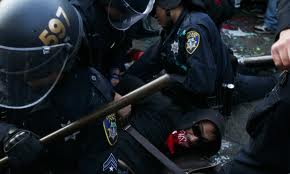
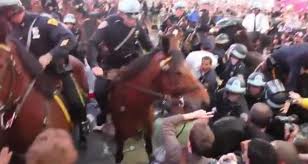
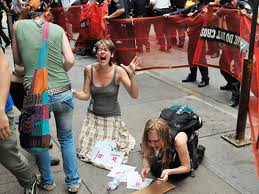
So disillusionment with the powers that be, anger and outrage at bailouts for banks and austerity for everyone else, disappointment with the lack of economic opportunity and excessive debt that can consequently never be paid back, are among the reasons that have led to the formation of the #OWS (Occupy Wall Street) movement. After two months of peaceful protest and civil disobedience, the protesters have been attacked by the police in a concerted action across the country. Now, the police are obviously here to protect and serve the top one percent of the populationthat has most of the income and to kick the shit out of anybody else who dares to dissent or protest. Hyperbole, you say? Looking at the following pictures will make even the most law-abiding citizen cringe with disgust, disillusionment and despair. These emotions should quickly give way to outrage, anger and the determination to DO SOMETHING, anything, to fight not only against this level of crass brutality that is not to be accepted or tolerated, but against the corrupt, destructive finance driven junta that seems to have taken over the countries of the West, in what Simon Johnson called the quiet coup.
Yves Smith of nakedcapitalism.com/ fame has another awesome post demolishing economists' dogma. In The Sorrow and the Pity of Economists (Like DeLong) Not Learning from Their Mistakes she takes apart an argument by one of the few economists who is actually willing to admit to mistakes, and is to be respected for that, but is unfortunately stuck in a world of models that have nothing to do with the real world and misrepresent what the founder of macroeconomics said anyway.
Delong says: There is only one real law of economics: the law of supply and demand. If the quantity supplied goes up, the price goes down
Unfortunately for the discipline of economics this is not true: Steve Keen's lectures on behavioural finance are a great place to become disabused of the notion that there are any laws of economics and the lectures provide an enlightening and insightful introduction to a more realistic approach to economics and finance.
But back to Yves:
No, it’s NOT the law, it’s a belief and it often is not operative...DeLong then argues that he and presumably his colleagues ignored the notions of John Hicks, the English economist who formalized the idea of Keynes’ General Theory and turned it into a special case of neoclassical economics. Keynes himself repudiated it, as did Hicks in his eighties....
Why would Keynes not like this treatment? Keynes, himself a successful speculator, did not think financial markets had any propensity to equilibrium, and there is separately reason to think the equilibrium assumption that the discipline has embraced to make its mathematics “tractable” is bollocks. The equilibrium assumption (more accurately, ergodicity) makes it impossible to incorporate any phenomena that are destabilizing, such as ones with positive (self-reinforcing feedback loops. Yet as we discuss short form in ECONNED (and George Cooper gives an elegant layperson treatment in The Origin of Financial Crises: Central Banks, Credit Bubbles, and the Efficient Market Fallacy), financial markets have no propensity to equilibrium. They are inherently prone to boom-bust cycles.
Even though Hicks’ story, via DeLong, bears some resemblance to Keynes’ liquidity preferences idea, it posits different causal channels that render them fundamentally different. In really simple terms, there is a “loanable funds” market in which borrowers and savers meet to determine the price of lending. Keynes argued that investors could have a change in liquidity preferences, which is econ-speak for they get freaked out and run for safe havens, which in his day was to pull it out of the banking system entirely. Hicks endeavored to show that the loanable funds and liquidity preferences theories were complementary, since he contended that Keynes ignored the bond market (loanable funds) while his predecessors ignored money markets.
But that’s a deliberate misreading. Keynes saw the driver as the change in the mood of capitalists; the shift in liquidity preferences was an effect. (In addition, Keynes held that changes with respect to existing portfolio positions, meaning stocks of held assets, would tend to swamp flow effects captured by loanable funds models.)
Making money cheaper is not going to make anyone want to take risk if they think the fundamental outlook is poor. Except for finance-intensive firms (which for the most part is limited to financial services industry incumbents), the cost of money is usually not the driver in business decisions, Market potential, the absolute level of commitment required, competitor dynamics and so on are what drive the decision; funding cost might be a brake. So the idea that making financing cheaper in and of itself is going to spur business activity is dubious, and it has been borne out in this crisis, where banks complain that the reason they are not lending is lack of demand from qualified borrowers. Surveys of small businesses, for instance, show that most have been pessimistic for quite some time.
If you want to put it in more technical terms, what is happening is a large and sustained fall in what Keynes called the marginal efficiency of capital. Companies are not reinvesting at a rate sufficient rate to sustain growth, let alone reduce unemployment. Rob Parenteau and I discussed the drivers of this phenomenon in a New York Times op-ed on the corporate savings glut last year: that managers and investors have short term incentives, and financial reform has done nothing to reverse them. Add to that that in a balance sheet recession, the private sector (both households and businesses) want to reduce debt, which is tantamount to saving. Lowering interest rates is not going to change that behavior. And if you try to generate inflation in this scenario, when individuals and companies are feeling stresses, all you do is reduce their real spending (and savings power) and further reduce demand (and hence economic activity).
So what Keynes thought important was to get investors to stop being "freaked out", decrease their liquidity preference, and again see the marginal efficiency of capital as sufficient to warrant further investment.
Back to Yves:
Marshall Auerback, by e-mail, points out that liquidity trap thinking is based on the idea that banks lend out of bank reserves. It has been shown empirically that banks lend first and reserve creation follows (that is, when needed, central banks accommodate loan creation):
The liquidity trap idea seems to be predicated on the silly idea that banks lend out reserves and failure to do so is symptomatic of a liquidity trap. But idea that the build up of bank reserves represent a pot of funds that the banks will eventually loan out completely misunderstands the role of bank reserves. But as Randy Wray, Bill Mitchell, Scott Fullwiler, Stephanie Kelton and a host of others have noted before banks do not loan out reserves. Reserves facilitate the payments system – that is, the system that assures the millions of transactions between banks (as customers write cheques and deposit them throughout the banking system).
Banks do not make loans on the basis of the reserves they hold. They respond to demands from credit-worthy customers and have in mind what it will cost them to make the loans under current conditions. When the transactions that follow the creation of a loan transpire it might be that the is short of reserves to ensure the payments clear. It has various options. It can seek funds from wholesale markets (other banks or other lenders), use deposits (not an overnight option really) or, ultimately, it can source the funds from the central bank.
The point is that you can get various levels of bank reserves depending on how the central bank pursues its liquidity management in order to hit its target policy rate. None of those levels have any particular operational significance.
The mainstream then argue that if the central bank mops up these reserves it will be less inflationary than if it leaves them in the system. This view is based on the spurious – banks lend reserves argument. The inflation risk associated with government spending is the same whether the government issues debt to match its deficit or not. The inflation risk arises from the impact of the spending on the state of capacity in the economy.
This is why fiscal stimulus is vastly more effective than monetary policy at times like these: it has a direct impact on overall conditions, by stimulating demand. Government spending creates more income for businesses and ultimately, consumers. Everyone’s income is ultimately someone else’s spending. If government increase spending, it will increase the incomes of at least some people in the economy, and the improvement in their fortunes (if they believe the new income level will be sustained) will lead them to spend more, improving the affairs of yet more people.
So the stimulation of demand is to be achieved by an improvement in overall conditions and this can best be done through fiscal policy, the aversion to which is not a matter of economics but ideology as pointed out by Edward Harrison from creditwritedowns.
But the important point is that because his General Theory was unfortunately written in a manner that few could understand too well, the wrong lessons have been drawn from Keynes and propounded all these years. It is my contention that Keynes was not only the founder of macroeconomics, but also a behavioral economist, and his insights into the psychology of investors and the economy are invaluable and should be taken to heart.
In my post on Hyman Minskys financial instability hypothesis there is a long quote from Keynes's 1937 article in the Quarterly Journal of economics, where he explained his views more clearly:
Actually, however, we have, as a rule, only the vaguest idea of any but the most direct consequences of our acts. Sometimes we are not much concerned with their remoter consequences, even tho time and chance may make much of them. But sometimes we are intensely concerned with them, more so, occasionally, than with the immediate consequences. Now of all human activities which are affected by this remoter preoccupation, it happens that one of the most important is economic in character, namely. Wealth. The whole object of the accumulation of Wealth is to produce results, or potential results, at a comparatively distant, and sometimes at an indefinitely distant, date. Thus the fact that our knowledge of the future is fluctuating, vague and uncertain, renders Wealth a peculiarly unsuitable subject for the methods of the classical economic theory. This theory might work very well in a world in which economic goods were necessarily consumed within a short interval of their being produced. But it requires, I suggest, considerable amendment if it is to be applied to a world in which the accumulation of wealth for an indefinitely postponed future is an important factor; and the greater the proportionate part played by such wealth-accumulation the more essential does such amendment become. By "uncertain" knowledge, let me explain, I do not mean merely to distinguish what is known for certain from what is only probable. The game of roulette is not subject, in this sense, to uncertainty; nor is the prospect of a Victory bond being drawn. Or, again, the expectation of life is only slightly uncertain. Even the weather is only moderately uncertain. The sense in which I am using the term is that in which the prospect of a European war is uncertain, or the price of copper and the rate of interest twenty years hence, or the obsolescence of a new invention, or the position of private wealthowners in the social system in 1970. About these matters there is no scientific basis on which to form any calculable probability whatever. We simply do not know. Nevertheless, the necessity for action and for decision compels us as practical men to do our best to overlook this awkward fact and to behave exactly as we should if we had behind us a good Benthamite calculation of a series of prospective advantages and disadvantages, each multiplied by its appropriate probability, waiting to he summed. How do we manage in such circumstances to behave in a manner which saves our faces as rational, economic men? We have devised for the purpose a variety of techniques, of which much the most important are the three following: (1) We assume that the present is a much more serviceable guide to the future than a candid examination of past experience would show it to have been hitherto. In other words we largely ignore the prospect of future changes about the actual character of which we know nothing.
(2) We assume that the existing state of opinion as expressed in prices and the character of existing output is based on a correct summing up of future prospects, so that we can accept it as such unless and until something new and relevant comes into the picture.
(3) Knowing that our own individual judgment is worthless, we endeavor to fall back on the judgment of the rest of the world which is perhaps better informed. That is, we endeavor to conform with the behavior of the majority or the average. The psychology of a society of individuals each of whom is endeavoring to copy the others leads to what we may strictly term a conventional judgment. Now a practical theory of the future based on these three principles has certain marked characteristics. In particular, being based on so flimsy a foundation, it is subject to sudden and violent changes. The practice of calmness and immobility, of certainty and security, suddenly breaks down. New fears and hopes will, without warning, take charge of human conduct. The forces of disillusion may suddenly impose a new conventional basis of valuation. All these pretty, polite techniques, made for a well-panelled Board Room and a nicely regulated market, are liable to collapse. At all times the vague panic fears and equally vague and unreasoned hopes are not really lulled, and lie but a little way below the surface. Perhaps the reader feels that this general, philosophical disquisition on the behavior of mankind is somewhat remote from the economic theory under discussion. But I think not. Tho this is how we behave in the market place, the theory we devise in the study of how we behave in the market place should not itself submit to market-place idols. I accuse the classical economic theory of being itself one of these pretty, polite techniques which tries to deal with the present by abstracting from the fact that we know very little about the future. I daresay that a classical economist would readily admit this. But, even so, I think he has overlooked the precise nature of the difference which his abstraction makes between theory and practice, and the character of the fallacies into which he is likely to be led.
So this is the crux of Keynes's theory and even an ostensibly Keynesian economist such as Brad DeLong unfortunately fails to draw the correct lessons from the theory. As pointed out by Yves and many others who contribute to the current discussion of the dismal state of the dismal science, it is confidence and lack thereof that determines economic recovery or depression, and not the sacred cows of supply and demand.
Countdown 3/2/10: Excerpt from Econned
Folks, the time has come when I must start shamelessly promoting my book, Econned: How Unenlightened Self Interest Undermined Democracy and Corrupted Capitalism, which is being released March 2, 2010.
I thought the extract below would give readers an idea of what the book is about, with one caveat. Econned goes into some detail about crisis mechanisms (as in why it got as bad as it did) and has unearthed a heretofore unexamined hedge fund trading strategy that turned the subprime mania into the detonator of the global debt bomb (and yes, we have the goods).
Enjoy!
In 1776, Adam Smith published The Wealth of Nations. In it, he argued that the uncoordinated actions of large numbers of individuals, each acting out of self-interest, sometimes produced, as if by “an invisible hand,” results that were beneficial to broader society. Smith also pointed out that self-interested actions frequently led to injustice or even ruin. He fiercely criticized both how employers colluded with each other to keep wages low, as well as the “savage injustice” that European mercantilist interests had “commit[ted] with impunity” in colonies in Asia and the Americas.
Smith’s ideas were cherry-picked and turned into a simplistic ideology that now dominates university economics departments. This theory proclaims that the “invisible hand” ensures that economic self-interest will always lead to the best outcomes imaginable. It follows that any restrictions on the profit-seeking activities of individuals and corporations interfere with this invisible hand, and therefore are “inefficient” and nonsensical.
According to this line of thinking, individuals have perfect knowledge both of what they want and of everything happening in the world at large, and so they pass their lives making intelligent decisions. Prices may change in ways that appear random, but this randomness follows predictable, unchanging rules and is never violently chaotic. It is therefore possible for corporations to use clever techniques and systems to reduce or even eliminate the risks associated with their business. The result is a stable, productive economy that represents the apex of civilization.
This heartwarming picture airbrushes out nearly all of the real business world. Yet uncritical allegiance to these precepts over the last thirty years has produced a world in which corporations, especially in finance, are far less restricted in their pursuit of profit. We show in this book how this lawless environment has led the financial services industry to pursue its own unenlightened
self-interest. The industry has become systematically predatory. Employees of industry firms have not confined their predation to outsiders; their efforts to loot their own firms nearly destroyed the industry and the entire global economy. Similarly destructive behavior by other players, often viewed through a distorted lens that saw all unconstrained commercial behavior as virtuous, added more
fuel to the conflagration.
Some economists have opposed this prevailing ideology; indeed, comparatively new lines of inquiry focus explicitly on how economic actors can fool themselves or others into making poor, even destructive, choices.
But when the economics profession has used the megaphone of its authority to dominate discussions with policymakers and the public, it has spoken with one voice, and the message has been the one described here. We therefore confine our criticism to these particularly influential ideas.
Theories that fly in the face of reality often need to excise inconvenient phenomena, and mainstream economics is no exception. Idealizing the rational aspects of business decisions means refusing to notice behavior that is predatory, destructive, criminal, or simply stupid. Believing that risk is manageable through mechanical systems has required not just unrealistic assumptions but also willful
blindness to clear signs of danger.
We offer here another point of view. This book lays bare both the actions leading to the credit crisis and the economic constructs that defended, facilitated, and even exacerbated this behavior. Our case makes clear that if our economic system is to harness the self-interest of individuals to achieve the general
good, it must be supervised within a democratic society and responsive to criticism by outside voices of those who are unafraid to think independently.
Most of the blogosphere has been skeptical of the rally in equities since the beginning, with ZeroHedge pointing out that the rise can be attributed, basically, to free money courtesy of the Federal Reserve, and aided and abetted by High Frequency Trading and the principal program trading of the usual suspects. Now, even for those who are not conspiracy minded, charts such as these speak volumes(pun intended).
I would like to point out one possible explanation for this phenomenon from a contentious source that I have quoted before. I maintian that Keynes is misunderstoond by many and that he is not the source of all wisdom, but, rather, someone who asked the right questions at the right time and pointed out many problems in the workings of the economy in periods of turmoil.
Unfortunately a serious fall in the marginal efficiency of capital also tends to affect adversely the propensity to consume. For it involves a severe decline in the market value of Stock Exchange equities. Now, on the class who take an active interest in their Stock Exchange investments, especially if they are employing borrowed funds, this naturally exerts a very depressing influence. These people are, perhaps, even more influenced in their readiness to spend by rises and falls in the value of their investments than by the state of their incomes. With a "stock-minded" public as in the United States to-day, a rising stock-market may be an almost essential condition of a satisfactory propensity to consume; and this circumstance, generally overlooked until lately, obviously serves to aggravate still further the depressing effect of a decline in the marginal efficiency of capital.
When once the recovery has been started, the manner in which it feeds on itself and cumulates is obvious. But during the downward phase, when both fixed capital and stocks of materials are for the time being redundant and working-capital is being reduced, the schedule of the marginal efficiency of capital may fall so low that it can scarcely be corrected, so as to secure a satisfactory rate of new investment, by any practicable reduction in the rate of interest. Thus with markets organised and influenced as they are at present, the market estimation of the marginal efficiency of capital may suffer such enormously wide fluctuations that it cannot be sufficiently offset by corresponding fluctuations in the rate of interest. Moreover, the corresponding movements in the stock-market may, as we have seen above, depress the propensity to consume just when it is most needed. In conditions of laissez-faire the avoidance of wide fluctuations in employment may, therefore, prove impossible without a far-reaching change in the psychology of investment markets such as there is no reason to expect. I conclude that the duty of ordering the current volume of investment cannot safely be left in private hands.
The point of contention is, and has been, the last sentence, which raises the blood pressure of everyone involved, on both sides, like nothing else ever written about economics (save maybe Marx). I am not venturing out on a limb when I say that the powers that be have read this passage and drawn their own conclusions from it. Even Greenspan said :
The rise in global stock prices from early March to mid-June is arguably the primary cause of the surprising positive turn in the economic environment. The $12,000bn of newly created corporate equity value has added significantly to the capital buffer that supports the debt issued by financial and non-financial companies. Corporate debt, as a consequence, has been upgraded and yields have fallen. Previously capital-strapped companies have been able to raise considerable debt and equity in recent months. Market fears of bank insolvency, particularly, have been assuaged
.
Juxtaposing these two quotes does not a proof of a government engineered market melt-up make, but one does have to wonder.
Robert Shiller is perhaps best known for his Case-Shiller home price index and for having correctly identified the previous bubble in financial markets in his 2000 book Irrational Exuberance . Shiller is concerned with risk and uncertainty in human affairs and has never been a proponent of the orthodoxy which either claims that bubbles do not exist(!) or that markets should be left to themselves since they instantly and efficiently incorporate all known information, something known as the Efficient Market Hypothesis . Barry Ritholz discusses the hubris of economics in a must read post, and over at Washington´s Blog another great post points out that economists had a incentive to be wrong.
Now Robert Shiller´s criticism of prevailing economic orthodoxy may not be as acid but it is nevertheless a damning indictment. Below is his lecture on Behavioral Finance and a very informative article on the decline (one would hope) of the Efficient Markets Theory and the rise of Behavioral Finance.
There is nothing like a crisis of momentous proportions to focus the mind. The intellectual edifice that was neo-classical economics came crumbling down last fall, something admitted by none other than the guru of efficient self-regulating markets himself, Alan Greenspan.
Now a well worn phrase has been that "no one could have seen this coming." Well, that is just not true; many did. And what set them apart from the cheering herd and its Panglossian view that all is for the best in this best of all worlds is that they did not drink from the neo-classical ideological kool-aid.
Hyman Minsky is about the last person asset managers would want to be mentioning in their letters to their clients (I cannot recall where I originally read this, or I would attribute credit). Minsky is perhaps best known for his Financial Instability Hypothesis which is being wonderfully articulated by Steve Keen at his debt deflation blog , along with the good folks over at the Center for Full Employment and Price Stability and many others.
Why the resurgence in interest in Minsky? Well, he explained and expanded ideas set forth by Keynes, who did not believe that markets were efficient and self-regulating. The price of an asset was not always the correct price.
From Keynes´s article in 1937:
Actually, however, we have, as a rule, only the vaguest idea of any but the most direct consequences of our acts. Sometimes we are not much concerned with their remoter consequences, even tho time and chance may make much of them. But sometimes we are intensely concerned with them, more so, occasionally, than with the immediate consequences.
Now of all human activities which are affected by this remoter preoccupation, it happens that one of the most important is economic in character, namely. Wealth. The whole object of the accumulation of Wealth is to produce results, or potential results, at a comparatively distant, and sometimes at an indefinitely distant, date. Thus the fact that our knowledge of the future is fluctuating, vague and uncertain, renders Wealth a peculiarly unsuitable subject for the methods of the classical economic theory. This theory might work very well in a world in which economic goods were necessarily consumed within a short interval of their being produced. But it requires, I suggest, considerable amendment if it is to be applied to a world in which the accumulation of wealth for an indefinitely postponed future is an important factor; and the greater the proportionate part played by such wealth-accumulation the more essential does such amendment become.
By "uncertain" knowledge, let me explain, I do not mean merely to distinguish what is known for certain from what is only probable. The game of roulette is not subject, in this sense, to uncertainty; nor is the prospect of a Victory bond being drawn. Or, again, the expectation of life is only slightly uncertain. Even the weather is only moderately uncertain. The sense in which I am using the term is that in which the prospect of a European war is uncertain, or the price of copper and the rate of interest twenty years hence, or the obsolescence of a new invention, or the position of private wealthowners in the social system in 1970. About these matters there is no scientific basis on which to form any calculable probability whatever. We simply do not know. Nevertheless, the necessity for action and for decision compels us as
practical men to do our best to overlook this awkward fact and to behave exactly as we should if we had behind us a good Benthamite calculation of a series of prospective advantages and disadvantages, each multiplied by its appropriate probability, waiting to he summed.
How do we manage in such circumstances to behave in a manner which saves our faces as rational, economic men? We have devised for the purpose a variety of techniques, of which much the most important are the three following:
(1) We assume that the present is a much more serviceable guide to the future than a candid examination of past experience would show it to have been hitherto. In other words we largely ignore the prospect of future changes about the actual character of which we know nothing.
(2) We assume that the existing state of opinion as expressed in prices and the character of existing output is based on a correct summing up of future prospects, so that we can accept it as such unless and until something new and relevant comes into the picture.
(3) Knowing that our own individual judgment is worthless, we endeavor to fall back on the judgment of the rest of the world which is perhaps better informed. That is, we endeavor to conform with the behavior of the majority or the average. The psychology of a society of individuals each of whom is endeavoring to copy the others leads to what we may strictly term a conventional judgment.
Now a practical theory of the future based on these three principles has certain marked characteristics. In particular, being based on so flimsy a foundation, it is subject to sudden and violent changes. The practice of calmness and immobility, of certainty and security, suddenly breaks down. New fears and hopes will, without warning, take charge of human conduct. The forces of disillusion may suddenly impose a new conventional basis of valuation. All these pretty, polite techniques, made for a well-panelled Board Room and a nicely regulated market, are liable to collapse. At all times the vague panic fears and equally vague and unreasoned hopes are not really lulled, and lie but a little way below the surface.
Perhaps the reader feels that this general, philosophical disquisition on the behavior of mankind is somewhat remote from the economic theory under discussion. But I think not. Tho this is how we behave in the market place, the theory we devise in the study of how we behave in the market place should not itself submit to market-place idols. I accuse the classical economic theory of being itself one of these pretty, polite techniques which tries to deal with the present by abstracting from the fact that we know very little about the
future.
I daresay that a classical economist would readily admit this. But, even so, I think he has overlooked the precise nature of the difference which his abstraction makes between theory and practice, and the character of the fallacies into which he is likely to be led.
Keynes, John Maynard (1937). `The General Theory of Employment`, Quarterly Journal of Economics, 51. cited in Shaw, G.K. (198. The Keynesian Heritage: Volume I. pp.11-13
Minsky identified three types of finance: hedge, speculative and Ponzi. Once the Ponzi stage is reached, debt is taken on in the belief that asset prices will continue to rise which will enable the debt to be serviced. Needless to say, once asset prices start to fall many will default. This is what we are seeing now. From Wray and Tymoigne :
Minsky created a famous taxonomy of financing profiles undertaken by investing firms: hedge (prospective income flows are expected to cover interest and principle with a safe margin); speculative (near-term income flows will cover only interest, although it is expected that finance costs will fall, that income flows will rise, or that assets can be sold at a higher price later—in which case revenues will be sufficient to cover principle); and Ponzi (near-term receipts are insufficient to cover interest payments so that debt increases because the Ponzi unit borrows to cover interest payments). Over the course of an expansion, financial stances evolve from largely hedge to include ever rising proportions of speculative and even Ponzi positions. Some Ponzi positions are undertaken voluntarily (due, for example, to expectations that debt can be refinanced at much more favorable terms or that large capital gains can be realized from asset price appreciation), some are fraudulent (a “pyramid” scheme is an example, in which a crook dupes everlarger numbers of suckers to provide the funds to pay the earliest participants), and some result from disappointment (revenues are lower than expected or finance costs rise unexpectedly). Attempts to raise leverage and to move to more speculative positions can be frustrated at least temporarily: if results turn out to be more favorable than expected, an investor attempting to engage in speculative finance could remain hedge because incomes realized are greater than were anticipated. This is because as aggregate investment rises, it has a multiplier impact on effective demand that can raise sales beyond what had been expected. Later, Minsky explicitly incorporated the Kaleckian result that in the truncated model, aggregate profits equal investment plus the government’s deficit.7 Thus, in an investment boom, profits would be increasing along with investment, helping to validate expectations and encouraging even more investment. This added strength to his proposition that the fundamental instability in the capitalist economy is upward—toward a speculative frenzy (as investment generates profits), which breeds more investment.
Here is an in depth look at the work and ideas of Hyman Mynsky.
Paul Willmott has an interesting blog post in which he said that he is hoping for one L of a recovery and I have to say I concur wholeheartedly. The economic prognosticators , after peering into their respective crystal balls or tea leaves, have seen the future and declared it a V , U , W, square root and other exotic shapes. Now almost all observers are in agreement that the dreaded L shape which plagued Japan is to be avoided like the pest. Not so Wilmott, the whiz of quantitative finance. He asks:
"Have you any experience of Japan in the 1990s? Well I have. And it didn't seem too bad to me. Were there hordes of people begging on the subway? Not that I recall. Was it dangerous roaming the streets for fear of being mugged? No, it seemed safe enough when I was there. Was there high unemployment and general desititution? No. More on this anon.
Japan in the 1990s was, as it still is, a safe, enjoyable place, with a very high standard of living, and at the cutting edge technology wise. Not the hell hole that economists like to paint. And so I really cannot imagine what Japan would be like now if they'd had a V-shaped recovery. They'd all be communicating by telepathy and travelling via matter transporter I guess.
To me the important point about the economy is not what letter of the alphabet best represents it, nor its percentage growth. After all, is it really necessary to grow at x percent per annum in order to maintain the feeling of status quo? Like the shark, which supposedly has to keep moving forward in order to stay alive. What sort of life is that? I believe what is most important is the well being of the people, and that's not the same as GDP. It is, however, closely linked to rate of employment. And that's where Japan does remarkably well. That's what governments should focus on, to L with growth!"
This flies in the face of the conventional economic wisdom which repeats the words growth and consumption in a manner resembling autism, someting duly noted by the post-autistic economics network .
"Our enormously productive economy demands that we make consumption our way of life, that we convert the buying and use of goods into rituals, that we seek our spiritual satisfactions, our ego satisfactions, in consumption. The measure of social status, of social acceptance, of prestige, is now to be found in our consumptive patterns. The very meaning and significance of our lives today expressed in consumptive terms. The greater the pressures upon the individual to conform to safe and accepted social standards, the more does he tend to express his aspirations and his individuality in terms of what he wears, drives, eats- his home, his car, his pattern of food serving, his hobbies.
These commodities and services must be offered to the consumer with a special urgency. We require not only “forced draft” consumption, but “expensive” consumption as well. We need things consumed, burned up, worn out, replaced, and discarded at an ever increasing pace. We need to have people eat, drink, dress, ride, live, with ever more complicated and, therefore, constantly more expensive consumption."
I would prefer instead to turn to Keynes:
"The full employment policy by means of investment is only one particular application of an intellectual theorem. You can produce the result as well by consuming more or working less. Personally I regard the investment policy as first aid… Less work is the ultimate solution.”
Much more on this topic can be found here at econospeak.
This has been posted again and again by the good folks at econospeak and I will do my part to try to disseminate the "memo."
THE LONG-TERM PROBLEM OF FULL EMPLOYMENT
J.M. Keynes (May 1943):
1. It seems to be agreed today that the maintenance of a satisfactory level of employment depends on keeping total expenditure (consumption plus investment) at the optimum figure, namely that which generates a volume of incomes corresponding to what is earned by all sections of the community when employment is at the desired level.
2. At any given level and distribution of incomes the social habits and opportunities of the community, influenced (as it may be) by the form and weight of taxation and other deliberate policies and propaganda, lead them to spend a certain proportion of these incomes and to save the balance.
3. The problem of maintaining full employment is, therefore, the problem of ensuring that the scale of investment should be equal to the savings which may be expected to emerge under the above various influences when employment, and therefore incomes, are at the desired level. Let us call this the indicated level of savings.
4. After the war there are likely to ensure [sic] three phases-
(i) when the inducement to invest is likely to lead, if unchecked, to a volume of investment greater than the indicated level of savings in the absence of rationing and other controls;
(ii) when the urgently necessary investment is no longer greater than the indicated level of savings in conditions of freedom, but it still capable of being adjusted to the indicated level by deliberately encouraging or expediting less urgent, but nevertheless useful, investment;
(iii) when investment demand is so far saturated that it cannot be brought up to the indicated level of savings without embarking upon wasteful and unnecessary enterprises.
5. It is impossible to predict with any pretence to accuracy what the indicated level of savings after the war is likely to be in the absence of rationing. We have no experience of a community such as ours in the conditions assumed, with incomes and employment steadily at or near the optimum level over a period and with the distribution of incomes such as it is likely to be after the war. It is, however, safe to say that in the earliest years investment urgently necessary will be in excess of the indicated level of savings. To be a little more precise the former (at the present level of prices) is likely to exceed £m1000 in these years and the indicated level of savings to fall short of this.
6. In the first phase, therefore, equilibrium will have to be brought about by limiting on the one hand the volume of investment by suitable controls, and on the other hand the volume of consumption by rationing and the like. Otherwise a tendency to inflation will set in. It will probably be desirable to allow consumption priority over investment except to the extent that the latter is exceptionally urgent, and, therefore, to ease off rationing and other restrictions on consumption before easing off controls and licences for investment. It will be a ticklish business to maintain the two sets of controls at precisely the right tension and will require a sensitive touch and the method of trial and error operating through small changes.
7. Perhaps this first phase might last five years,-but it is anybody's guess. Sooner or later it should be possible to abandon both types of control entirely (apart from controls on foreign lending). We then enter the second phase, which is the main point of emphasis in the paper of the Economic Section. If two-thirds or three-quarters of total investment is carried out or can be influenced by public or semi-public bodies, a long-term programme of a stable character should be capable of reducing the potential range of fluctuation to much narrower limits than formerly, when a smaller volume of investment was under public control and when even this part tended to follow, rather than correct, fluctuations of investment in the strictly private sector of the economy. Moreover the proportion of investment represented by the balance of trade, which is not easily brought under short-term control, may be smaller than before. The main task should be to prevent large fluctuations by a stable long-term programme. If this is successful it should not be too difficult to offset small fluctuations by expediting or retarding some items in this long-term programme.
8. I do not believe that it is useful to try to predict the scale of this long-term programme. It will depend on the social habits and propensities of a community with a distribution of taxed income significantly different from any of which we have experience, on the nature of the tax system and on the practices and conventions of business. But perhaps one can say that it is unlikely to be less than 7 per cent or more than 20 per cent of the net national income, except under new influences, deliberate or accidental, which are not yet in sight.
9. It is still more difficult to predict the length of the second, than of the first, phase. But one might expect it to last another five or ten years and to pass insensibly into the third phase.
10. As the third phase comes into sight; the problem stressed by Sir H. Henderson begins to be pressing. It becomes necessary to encourage wise consumption and discourage saving,-and to absorb some part of the unwanted surplus by increased leisure, more holidays (which are a wonderfully good way of getting rid of money) and shorter hours.
11. Various means will be open to us with the onset of this golden age. The object will be slowly to change social practices and habits so as to reduce the indicated level of saving. Eventually depreciation funds should be almost sufficient to provide all the gross investment that is required.
12. Emphasis should be placed primarily on measures to maintain a steady level of employment and thus to prevent fluctuations. If a large fluctuation is allowed to occur, it will be difficult to find adequate offsetting measures of sufficiently quick action. This can only be done through flexible methods by means of trial and error on the basis of experience, which has still to be gained. If the authorities know quite clearly what they are trying to do and are given sufficient powers, reasonable success in the performance of the task should not be too difficult.
13. I doubt if much is to be hoped from proposals to offset unforeseen short-period fluctuations in investment by stimulating short-period changes in consumption. But I see very great attractions and practical advantage in Mr Meade's proposal for varying social security contributions according to the state of employment.
14. The second and third phases are still academic. Is it necessary at the present time for Ministers to go beyond the first phase in preparing administrative measures? The main problems of the first phase appear to be covered by various memoranda already in course of preparation. insofar as it is useful to look ahead, I agree with Sir H. Henderson that we should be aiming at a steady long-period trend towards a reduction in the scale of net investment and an increase in the scale of consumption (or, alternatively, of leisure) but the saturation of investment is far from being in sight to-day The immediate task is the establishment and the adjustment of a double system of control and of sensitive, flexible means for gradually relaxing these controls in the light of day-by-day experience
I would conclude by two quotations from Sir H. Henderson's paper, which seem to me to embody much wisdom.
"Opponents of Socialism are on strong ground when they argue that the State would be unlikely in practice to run complicated industries more efficiency than they are run at present. Socialists are on strong ground when they argue that reliance on supply and demand, and the forces of market competition, as the mainspring of our economic system, produces most unsatisfactory results. Might we not conceivably find a modus vivendi for the next decade or so in an arrangement under which the State would fill the vacant post of entrepreneur-in-chief, while not interfering with the ownership or management of particular businesses, or rather only doing so on the merits of the case and not at the behests of dogma?
"We are more likely to succeed in maintaining employment if we do not make this our sole, or even our first, aim. Perhaps employment, like happiness, will come most readily when it is not sought for its own sake. The real problem is to use our productive powers to secure the greatest human welfare. Let us start then with the human welfare, and consider what is most needed to increase it. The needs will change from tune to time, they may shift, for example, from capital goods to consumers' goods and to services. Let us think in terms of organising and directing our productive resources, so as to meet these changing needs, and we shall be less likely to waste them."
There is some serious food for thought here, especially that it "becomes necessary to encourage wise consumption and discourage saving,-and to absorb some part of the unwanted surplus by increased leisure, more holidays (which are a wonderfully good way of getting rid of money) and shorter hours." But this train has left the station. We picked increased consumption to leisure and kept on working ourselves to death in a neverending rat´s race to keep up with the Joneses and driven by manufactured wants. What exactly is it about the 8 hour work day that is sacrosanct? Why does the conventional wisdom insist on equating happiness or welfare with consumption? Is consumption really the be all and end all of human existence? What a poor existence that would be. Unfortunately Keynes was all too soon forgotten and those pesky vested interests he mentioned in the closing pages of his General Theory have to date not stopped trying to discredit his ideas, many of which were misunderstood, never even implemented or seriously considered. Now we are left picking up the pieces of our orgy of consumption, excess and greed that began in the 1980´s. We would do well to read Keynes once more. The General Theory of Employment, Interest, and Money
One cannot read the following excerpt from Keynes without being impressed and disturbed by the fact that the same reasons were and are being set forth in support of neo-classical economics even after their complete and utter failure to predict, explain or provide solutions for the current crisis.
The completeness of the Ricardian victory is something of a curiosity and a mystery. It must have been due to a complex of suitabilities in the doctrine to the environment into which it was projected. That it reached conclusions quite different from what the ordinary uninstructed person would expect, added, I suppose, to its intellectual prestige. That its teaching, translated into practice, was austere and often unpaltable, lent it virtue. That it was adapted to carry a vast and consistent logical superstructure, gave it beauty. That it could explain much social injustice and apparent cruelty as an inevitable incident in the scheme of progress, and the attempt to change such things as likely on the whole to do more harm than good, commended it to authority. That it afforded a measure of justification to the free activities of the individual capitalist, attracted it to the support of the dominant social forces behind authority. But although the doctrine itself has remained unquestioned by orthodox economists up to a late date, its signal failure for purposes of scientific prediction has greatly impaired, in the course of time, the prestige of its practitioners. For professional economists...were apparently unmoved by the lack of correspondence between the results of their theory and the facts of observation;-a discrepancy which the ordinary man has not failed to observe, with the result of his growing unwillingness to accord economists that measure of respect which he gives to other groups of scientists whose theoretical results are confirmed by observation when they are applied to the facts.
John Maynard Keynes (1936) The General Theory of Employment, Interest and Money, Chapter 3
In my previous post I made the contention that we should not expect a robust recovery and that there was the risk of a "W" shaped double dip. Lets see what the consensus is and whether this is a normal recession as some "green shooters" claim, or something else entirely that no one really wants to acknowledge.
The chart plots the four-quarter growth rate of gross domestic product (GDP) from the trough of a recession against the depth of the corresponding contraction, as measured by the cumulative loss of GDP over the course of the downturn. The points within the red circle represent all previous postwar recessions, and they form a nice, neat, easily discernible pattern. That is, the pace of growth in the first year after a recession has, in our history, been reliably related to how bad the recession was. The deeper the recession, the faster the recovery.
The points within the blue circle are based on forecasts of GDP growth from the third quarter of this year through the third quarter of 2010, obtained from the latest issue of Blue Chip Economic Indicators (which reports survey results from "America's leading business economists"). From top left of the circle to bottom right, the points represent the 10 lowest forecasts of the most optimistic members of the 50 Blue Chip forecasting panel, the panel's consensus (or average) forecast, and the 10 highest forecasts of the most pessimistic panel participants.
I chose the third quarter as the reference point because nearly two-thirds of the Blue Chip respondents indicate that, in their view, the recession will indeed end in the third quarter of this year. Assuming this occurs, this recovery would appear to be a big outlier. Either we are about to continue making history—and not in a good way—or current guesses about the medium-term economy are way too pessimistic.
On another note, if you would like to do a little prognosticating of your own, I commend to you our new weekly editions of Economic Highlights and Financial Highlights.
By David Altig, senior vice president and research director at the Atlanta Fed
Well, if the consensus is that the recovery will be absolutely anemic, judging by these low prognostications, then perhaps the "this is a normal recession" meme form the MSM should be dropped because it is incompatible with the consensus forecasts. But we would not want to scare anyone with more truthful reporting, would we? As it turns out, judging by todays consumer confidence index , the US consumer has become cognizant that if one has no job, then there is little reason to rejoice and go on a shopping spree once again in order to jumpstart that 70% of the US economy that depends on consumer spending.
Having started reading John Kenneth Galbraith´s "The Great Crash: 1929" I cannot help but make a few observations. An old and esteemed professor of mine used to tell us that what was important in critical reading and writing was to answer these three questions: "What does it say? What does it mean? What difference does it make?" Today I can only address the first of these questions, saving the rest for later, hopefully. But back to the first chapter of "The Great Crash."
"[F]or a generation Democrats have been warning that to elect Republicans is to invite another disaster like that of 1929. The defeat of the Democratic candidate in 1952 was widely attributed to the unfortunate appearance at the polls of too many youths who knew only by hearsay of the horrors of those days."
"Historians and novelists always have known that tragedy wonderfully reveals the nature of man. But, while they have made rich use of war, revolution, and poverty, they have been singularly neglectful of financial panics. And one can relish the varied idiocy of human action during a panic to the full, for, while it is a time of great tragedy, nothing is being lost but money."
"On the whole, the greater the earlier reputation for omniscience, the more serene the previous idiocy, the greater the foolishness now exposed. Things that in other times were concealed by a heavy facade of dignity now stood exposed, for the panic suddenly, almost obscenely, snatched this facade away."
"No one was responsible for the great Wall Street crash. No one engineered the speculation that preceded it. Both were the product of the free choice and decisions of hundreds of thousands of individuals. The latter were not led to the slaughter. They were impelled to it by the seminal lunacy which has always seized people who are seized in turn with the notion that they can become very rich."
"It has long been my feeling that the lessons of economics that reside in economic history are important and that history provides an interesting and even fascinating window on economic knowledge."
"Finally, a good knowledge of what happened in 1929 remains our best safeguard against the recurrence of the more unhappy events of those days. Since 1929 we have enacted numerous laws designed to make securities speculation more honest and, it is hoped, more readily restrained."
"The signal feature of the mass escape from reality that occurred in 1929 and before - and which has characterized every previous speculative outburst from the South Sea Bubble to the Florida land boom - was that it carried Authority with it. Governments were either bemused as were the speculators or they deemed it unwise to be sane at a time when sanity exposed one to ridicule, condemnation for spoiling the game, or the threat of severe political retribution."
The relevance and parallels to the current crisis should be obvious.